INSIGHTS
How Sustainability shapes brand trust and AI discoverability
By Envirotivity | 19 September 2026 | 8 min read
Reputation is becoming harder to build and easier to misread. Here’s why credible sustainability evidence matters for your brand, your people and your future – and how AI is changing the way brands are discovered.
Products, services, technology, and even customer experiences can be copied quickly. What is harder to reproduce is the accumulated trust, credibility and preference a company has built with customers, talent, partners and markets.
The commercial stakes are significant. Edelman’s 2026 global brand research found that 88% of consumers consider trusting a brand an important or critical purchase criterion, almost equal to quality at 89% and value at 88%.
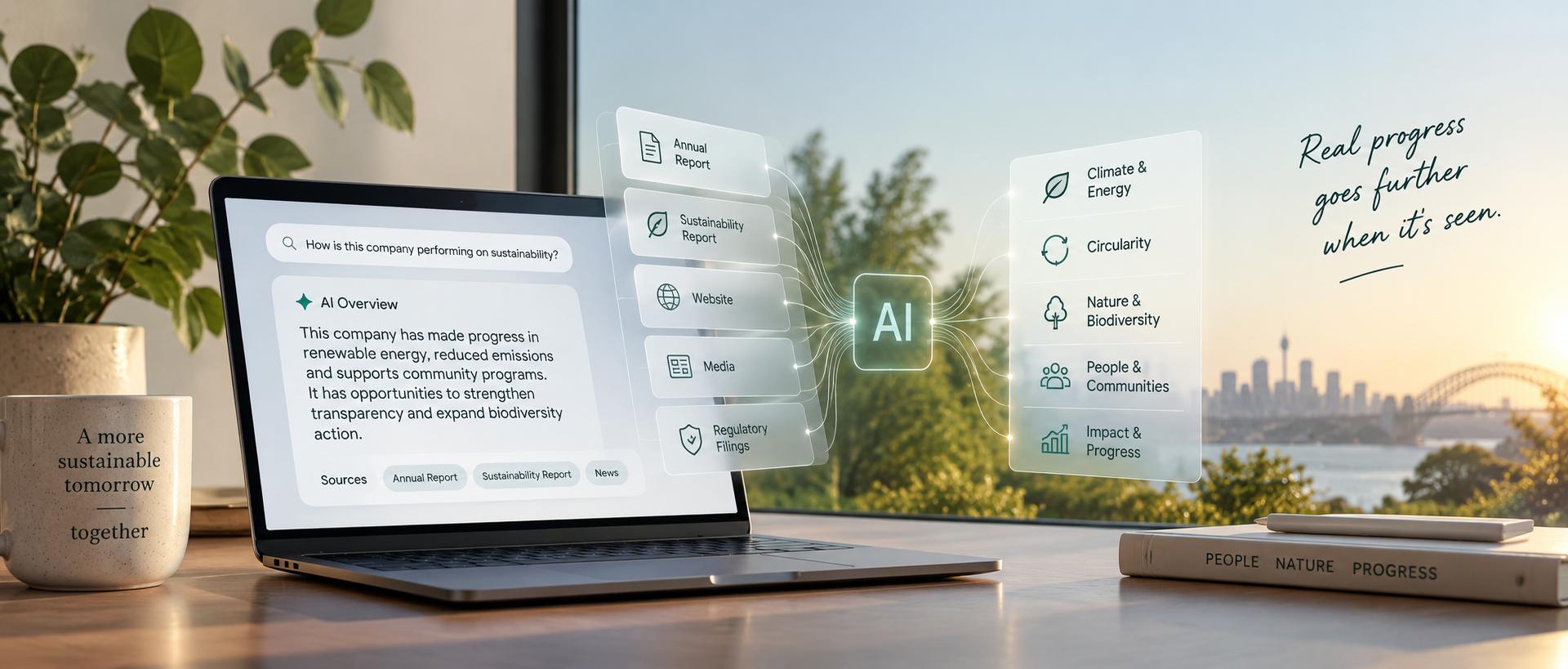
Reputation is not a soft PR metric. It influences who buys from you, who works for you, and who selects you as a supplier. And in an AI-driven market, discoverability matters: if your actual progress is difficult to find or easy to misinterpret, search tools and AI answer engines may form an incomplete picture of your organisation.
Sustainability is one part of that reputation. Its importance varies by industry and audience, but where it is material, credible sustainability performance can become a meaningful signal of trust, resilience and future-readiness.
[See How Envirotivity Structures Sustainability Evidence]
Where sustainability creates commercial value
Sustainability does not influence every organisation equally. Its importance increases when environmental or social issues sit close to the product, customer decision, enterprise procurement, regulation or licence to operate.
Retail & Consumer Goods
Customers encounter sustainability through visible product decisions: packaging, recyclability, waste, sourcing, durability and circularity. Here, sustainability is most commercially useful when it strengthens the product proposition rather than sitting separately as a corporate promise.
Food & Grocery
Sourcing, provenance, packaging, agriculture, food waste and supply-chain transparency are closely connected to the product itself. These are tangible issues customers can see, understand and compare.
Automotive & Mobility
Price, reliability, performance and running costs remain fundamental, but electrification, batteries, lifecycle emissions and transition readiness increasingly shape fleet procurement and wider perceptions of whether a brand is prepared for the future.
Property, Construction & Infrastructure
Sustainability affects a broader stakeholder group. Energy performance, materials, climate resilience, biodiversity and local impact can matter to investors, tenants, government, communities and corporate buyers.
Financial Services
The larger reputation question is often not the organisation’s office footprint. It is what the business finances, enables, invests in or insures — and whether those activities align with its stated commitments.
Energy, Resources & Utilities
Environmental impact sits close to the core business model. Emissions, land, biodiversity, water and community impact can directly affect trust and licence to operate.
Technology & Professional Services
Sustainability may be less central to the consumer proposition, but it can still matter through enterprise procurement, client expectations, data-centre energy use, employer reputation and talent.
The industry reveals where sustainability is material. The audience reveals why.
Different audiences need different proof
The same sustainability activity can create different commercial value depending on who is evaluating it.
- For customers, credible sustainability evidence can support trust, product preference and, in some categories, willingness to pay.
- For employees and talent, the value is different. Deloitte’s 2025 global survey found that 89% of Gen Zs and 92% of millennials consider a sense of purpose important to job satisfaction and wellbeing, while around 40% had rejected an assignment, project or potential employer because of personal ethics or beliefs.
- For procurement teams and B2B buyers, sustainability can become part of supplier assessment, reporting requirements and risk management.
- For investors and lenders, the focus may be transition readiness, resilience, regulatory exposure and long-term value.
- For communities and regulators, the questions are often about local impact, accountability and whether the organisation’s actions match its public commitments.
This is why the useful question is not simply, “Does sustainability matter?”
It is: Does this sustainability issue materially influence how an important audience sees the organisation?
A 2024 meta-analysis covering 92 empirical studies found a significant positive relationship between sustainability disclosure and corporate reputation, while also finding that the strength of that relationship varies by context and how reputation is measured.
From activity to reputation
Many established organisations already have meaningful sustainability activity. The challenge is that the supporting evidence is often fragmented across annual reports, climate disclosures, sustainability reports, internal programs, employee initiatives and community partnerships.
The gap is not always a lack of action.
It can be the gap between what an organisation is actually doing and what customers, employees, partners and markets can see and understand.
That matters because credible work creates limited reputation value if the people who matter cannot find it, interpret it or connect it to something relevant to them.
The opportunity is therefore not to communicate more loudly. It is to make the right evidence more visible, understandable and relevant — while staying within what that evidence can genuinely support.
Why sustainability communication is getting harder
Communicating progress has become more difficult.
Audiences are more sceptical. Scrutiny of environmental claims is increasing. Organisations are becoming more cautious about what they say.
That creates tension between two risks: greenwashing, where communication goes beyond what the evidence supports, and greenhushing, where organisations say very little even when credible progress exists.
Cost-of-living pressure adds another layer. Sustainability may still matter, but audiences increasingly expect it to connect to practical value: durability, efficiency, affordability, health, quality, reduced waste or resilience.
Broad claims such as “we care about the planet” are therefore becoming less useful.
The stronger communication question is:
What have we actually done, what evidence supports it, and why should this audience care?
AI is changing how reputation is discovered
There is also a new intermediary between organisations and their audiences: AI-driven search and conversational discovery.
Instead of navigating through multiple reports and corporate websites, people increasingly ask AI tools direct questions about companies, products, suppliers and reputation.
AI systems can synthesise information from websites, formal reports, media coverage and other public sources. The clearer and more specific that information is, the more useful context those systems have to work with.
That creates a new visibility challenge.
A company may have strong evidence buried inside a long disclosure document, while a competitor has simpler, clearer and more accessible public information. The underlying performance may not be better — but one organisation is easier to understand.
For organisations, the practical questions are:
Is it public? Can search engines and AI systems locate it?
Is it current? Does it reflect the latest reporting cycle?
Is it specific? Are claims grounded in clear metrics, actions or outcomes rather than broad pledges?
Is it traceable? Can the underlying evidence be verified?
Is it consistent? Does the public website align with formal disclosures and other communications?
Is it understandable? Can people and AI systems easily determine what actually happened?
The objective is not to write for algorithms instead of people. It is to make credible information easier for both to find and interpret.
Built for credible sustainability communication.

ASIC and ACCC informed
Traceable evidence
Connected reporting
Credible claims
Where Envirotivity fits
Envirotivity is building a digital platform around a simple problem: organisations often have credible sustainability activity, but the evidence is fragmented and difficult to use beyond formal reporting.
The platform is designed to bring that evidence together, help organisations understand what is credible and relevant to communicate, connect employees with practical sustainability experiences, and turn verified activity into stronger engagement, reporting, communications and brand value.
The aim is not to manufacture a sustainability story.
It is to help organisations make better use of the real work they are already doing — and make credible progress easier for customers, employees, partners, search engines and AI systems to understand.
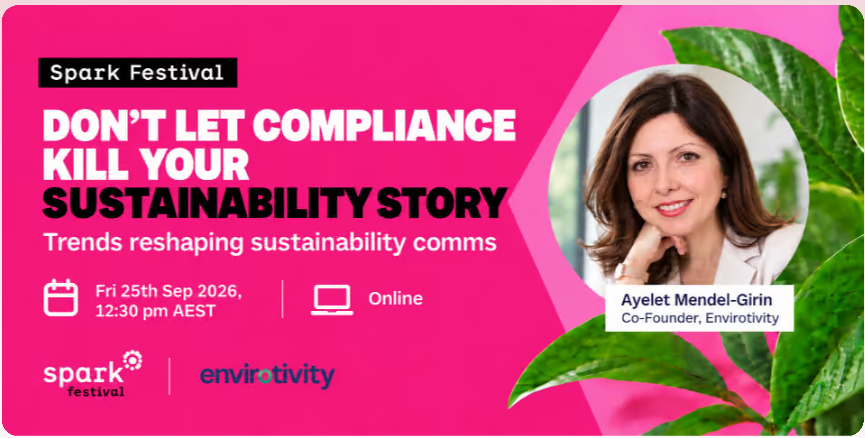
Watch the Spark Festival session
Don’t Let Compliance Kill Your Sustainability Story
In this session, Envirotivity explores how sustainability evidence shapes brand trust, greenwashing risk and AI discoverability — and why making credible progress easier to find and understand is becoming part of reputation management.
Key takeaways
- Sustainability matters differently by industry and audience.
- Credible evidence is more valuable than broad sustainability claims.
- Greenwashing and greenhushing are both communication risks.
- AI search is changing how companies are discovered and represented.
- Better visibility starts with clear, traceable evidence.
Turn sustainability evidence into credible visibility

Bring together the sustainability work you are already doing, understand what the evidence supports, and make credible progress easier for people, search engines and AI systems to find and understand.
Identify
Bring together sustainability activity and supporting evidence in one clear view.
Validate
Check what the evidence supports and what can be communicated credibly.
Communicate
Turn verified progress into clear, credible comms and discoverable evidence.